


Renovating an apartment in Monaco: procedures and permits
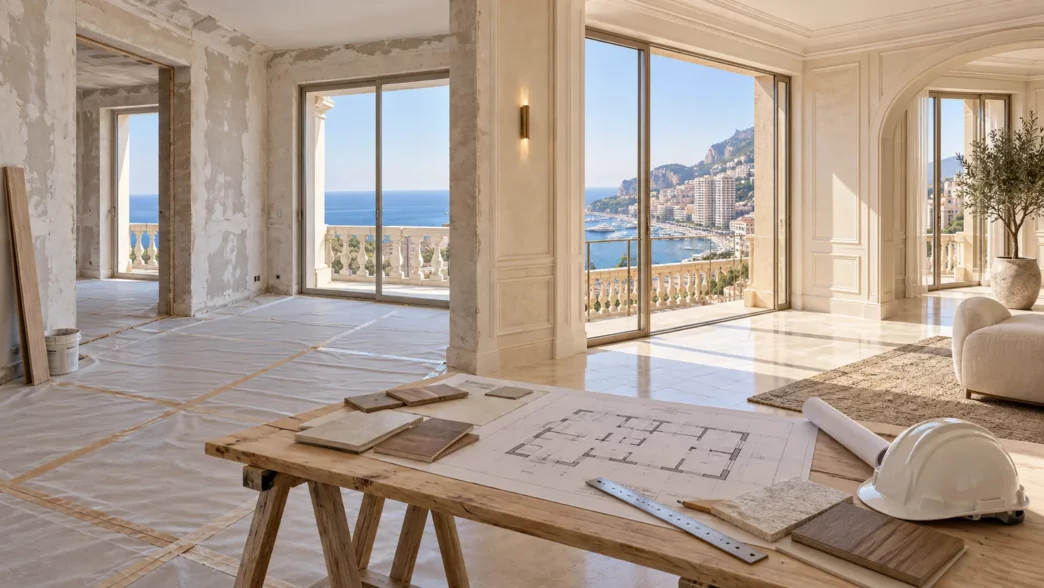
Define the project before organising the work. AI-generated conceptual illustration; fictional apartment.
Renovating an apartment in Monaco starts with two questions: what work is planned, and how will it be organised within the building? Redecoration mainly requires coordination with the condominium. Altering the apartment also means planning for permits and completion checks.
For straightforward redecoration
This means decorative work, such as repainting walls or replacing wallpaper, without changing rooms, partitions, load-bearing walls, building services or the exterior.
Repainting a kitchen and relocating that kitchen are different projects. Relocation changes the layout and services even without affecting a load-bearing wall. An internal alteration may require permission without creating an extra room. If unsure, send the DPUM a precise description of the work, with your architect’s help if needed, to confirm the applicable procedure. Scope of permit requirements.
1. Inform the building manager and check permitted working hours
Always contact the condominium’s managing agent, or syndic, before work starts. Provide a description, planned dates, contractors’ names and a contact number.
Ask the managing agent about working hours, protection of common areas and waste removal. The building may, for example, prohibit work between 18:00 and 08:00, at weekends or during August. Confirm these rules before booking contractors.
National framework. Work is permitted on working days from Monday to Friday, 07:30–19:30, with measures to reduce disturbance. Certain noisy operations face additional restrictions; the condominium may impose stricter hours.
Special rules for August. From the first Monday to the last Friday inclusive, only phase 3 work — finishing trades, equipment and interior fitting-out as defined in the regulation — is allowed, 09:00–18:00, without noise, vibration or visual nuisance. The condominium may prohibit all work during this period. Working hours and permitted periods.
For projects covered by the rules, an identified contact person and information about the work and its disturbance are also required. Information about building work.
2. Notify the concierge and arrange contractor parking
Tell the concierge the dates and times of the work. If the building has service parking spaces, ask the concierge to arrange a reservation for the contractor, involving the managing agent where necessary, subject to availability and building rules. Also agree on use and protection of the lift or goods lift.
If no space is available, a public-road parking reservation can be requested from the Town Hall. The official parking reservation page, also used for deliveries, provides the form. Specify that the vehicle belongs to a building contractor and ask the Municipal Police to confirm the appropriate category.
Download the form online and submit it, including by email to pmovp@mairie.mc, at least five working days before occupying the space. Give dates, times, address, number of spaces and vehicle details. The permit is issued after payment. Enquiries: +377 93 15 28 26.
A skip or scaffolding requires a separate construction-site occupation application, submitted at least one month in advance with the requested documents, including a dimensioned plan.
For more complex renovation work
These projects alter the apartment’s layout, load-bearing walls, services, common areas or exterior. They require the following steps in addition to coordination with the managing agent and concierge.
1. Prepare the project with an architect and obtain approvals
Appoint an architect registered with the Ordre des Architectes de Monaco to prepare the plans and application. Depending on the agreed scope of services, the architect prepares a project estimate and helps obtain detailed contractor quotations. Arrange suitable structural studies for load-bearing walls; for pipework, identify private and common components. Official works-permit procedure.
If the work affects common areas or the external appearance, prepare its presentation to the owners’ general meeting with the managing agent, calling an additional meeting if needed. First check whether the managing agent has a special mandate allowing certain work on common components within private units to be approved under the statutory conditions. Condominium approval.
The project must also be submitted to the Direction de la Prospective, de l’Urbanisme et de la Mobilité — DPUM for the required administrative permission. Start after obtaining the necessary approvals, following the approved plans and conditions. Condominium consent does not replace administrative approval.
2. Record the condition of the apartment and neighbouring areas before work
Before work that could cause cracks, vibration or water ingress, preferably arrange a formal condition report by an huissier, a judicial officer. This records the condition of the apartment, common areas and exposed neighbouring homes, with occupants’ consent for access.
This recommended precaution allows conditions before and after the work to be compared. The report provides useful evidence if damage occurs, although identifying its cause may require a technical expert assessment.
With the architect, also arrange the formal record that the permit has been displayed. This is a separate requirement, and a copy must be sent to the DPUM. Displaying the permit.
3. Arrange completion inspections and final checks
Acceptance of the contractor’s work: check delivery.
Arrange a visit with the contractors and, depending on the appointment, the architect. Inspect finishes, equipment and handover documents. List visible defects as reservations in the acceptance report, then agree on remedial work.
Electrical checks: obtain the appropriate certificate.
For new premises or a renovated electrical installation, SMEG requires a certificate of conformity issued by an inspection body approved in the Principality before commissioning. The electrician installs the system and carries out necessary corrections. Following a prolonged supply interruption, a separate certificate checking safety points may be required. Documents required by SMEG.
Récolement: check administrative compliance.
For permitted works, request the DPUM inspection within one month of completion, providing as-built plans and required documents. The DPUM brings together the relevant departments. Changes to the project may require an amended application or corrective work. Requesting a completion inspection.
This inspection covers permit conditions and hygiene, safety and environmental requirements. It complements acceptance of the contractor’s work without guaranteeing the general quality of materials or finishes, or the absence of defects.
Once the conditions are met, the récolement is accompanied by permission to occupy the premises, which should be checked before a tenant moves in. This document concerns occupation; for a sale, give the notary the exact status of the work and any outstanding reservations. Scope of the completion inspection.
Prefer established Monaco contractors and check their insurance
To simplify organisation, prefer contractors established in Monaco and familiar with local condominiums. Check evidence of their business activities and insurance for the work assigned, wherever they are based.
A foreign company may also operate subject to Monaco’s formalities. The procedure distinguishes work lasting no more than 48 hours from longer interventions, which require prior permission; subcontractors are also covered. Construction-site authorisation.
Ask each contractor for evidence of professional liability insurance and, for the works concerned, a copy of their ten-year liability cover. Check the insured activities, policy validity and territorial cover for Monaco. Ten-year liability and the existence of insurance are separate matters. Monaco Civil Code, Article 1630.
Keep quotations, invoices, plans, permits, reports and certificates: they will be useful when selling the apartment.
Which improvements should you prioritise before selling or letting? Discuss your project with Monaco Properties to identify suitable improvements for your apartment and prospective buyers or tenants before committing your budget.
Sources consulted on 15 September 2026. Permit conditions and the building’s own rules supplement this general framework.


